
Use the calculator nowRead the sizing guide ↓
Solar Battery Calculator: Size Your Battery Bank Free
Enter your daily energy use to size your lithium battery bank in kWh and amp-hours — a free instant calculator, no signup required.
Big HVAC and electric-heat loads (central AC, furnaces, heat strips) are battery hogs — off-grid homes usually lean on mini-splits, wood/pellet heat, or a generator for those. Add them to see the impact, then adjust runtime to match how you'd really use them.
These wattages and run-times are general averages — a solid starting point, not exact numbers. Real appliances vary, and for precise sizing we check your actual spec sheets. Edit any value to match your own gear. (Compare the monthly figure to your utility bill as a gut check.)
Stops around 80% to stretch cycle life — the longevity-first default. You can run a lithium pack deeper; it just cycles harder.
Formula & assumptions (for review)
Storage needed (kWh) = Daily kWh ÷ Depth of discharge (usable %)- Daily kWh = 5.30 kWh (summed from your appliance list)
- Depth of discharge = 80% usable — a longevity choice, not a safety limit (80% is the cycle-life default)
- = 5.30 ÷ 0.80 = 6.6 kWh. Amp-hours = kWh ÷ 48V. No specific battery module is picked here — that's a whole-system question.
For educational planning only. Confirm the final battery bank size with your equipment specs and, for anything critical, a qualified installer.
Your Battery Bank Size, Instantly
This free solar battery calculator tells you how much lithium storage your off-grid system needs — as a kilowatt-hour figure, an amp-hour rating, and a bank size you can shop against. Build it up from the appliances you plan to run (or type your daily kilowatt-hours), and the number is yours in under a minute.
One assumption drives it: depth of discharge — how much of a lithium pack you draw before recharging. The calculator defaults to 80% (leaving a reserve that stretches cycle life) and you can push deeper for a smaller bank. Every section below shows exactly where the number comes from, so the calculator is never a black box.
This tool answers one question: how big should your battery bank be? Sizing an entire off-grid setup — solar array, inverter, wiring, and cost? Use our Off-Grid System Calculator, which builds on the same battery math and adds the rest of the system around it.
Want the battery already matched to panels and inverter?A complete Unbound off-grid system pairs your battery bank with a matched array and inverter, so everything works together from day one. Price it around the number you just calculated.Get a complete system estimate →How Much Battery Storage Do You Need? The Formula
The calculator runs one core step you can also do by hand — it keeps the number honest and lets you sanity-check any quote you're given.
- Add up your daily energy useBuild it from the loads you actually plan to run off-grid — each appliance's watts × hours per day (the calculator's appliance list does this for you). A typical off-grid home lands between 5 and 15 kWh per day.
- Divide by your depth of dischargeYou only draw the usable share of a lithium pack before it's time to recharge — about 80% by default, which leaves a reserve that stretches cycle life. So a 10 kWh/day home needs 10 ÷ 0.8 = 12.5 kWh of lithium storage. (Run it deeper for a smaller bank; it just cycles harder.)
That sizes a normal day, where the sun refills the bank by afternoon. For the occasional long cloudy stretch, most off-grid homes lean on a generator rather than paying for a battery big enough to ride out weeks of clouds — it's the cheaper, more practical backstop. Sizing that full picture — array, generator, seasonality — is a quick conversation with our team.
Worked Example: A 10 kWh/Day Household
Here's the full math for a home that uses 10 kWh per day, sized with a lithium (LiFePO4) bank
| Step | Lithium (LiFePO4) |
|---|---|
| Daily energy use | 10 kWh |
| Depth of discharge | 80% usable (÷ 0.8) |
| Lithium storage needed | 12.5 kWh |
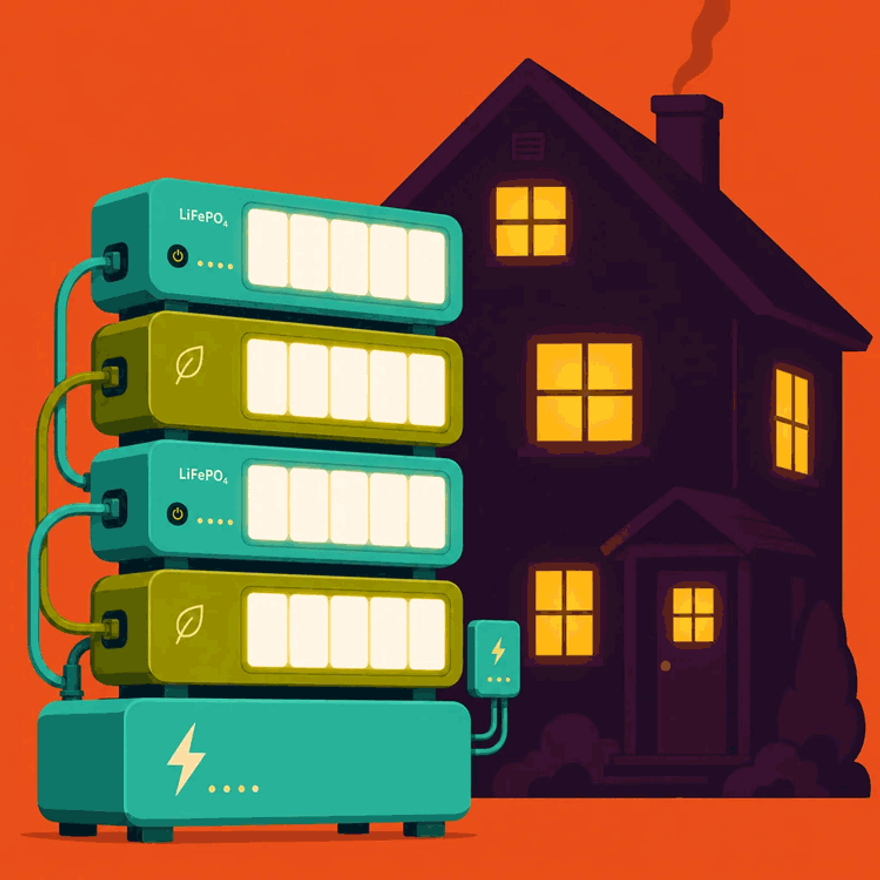
Because a LiFePO4 bank draws down deep (80%+), the size the calculator gives you stays close to your real daily energy need — no doubling-up to work around the shallow 50% discharge limit that lead-acid forces on you.
Depth of Discharge Explained
Depth of discharge (DoD) is the percentage of a battery's rated capacity you can use without shortening its life. It's the single biggest reason two "10 kWh" batteries can behave very differently.
| Battery type | Usable depth of discharge |
|---|---|
| Flooded lead-acid | ~50% |
| Sealed lead-acid (AGM/gel) | ~50% |
| Lithium (LiFePO4) | 80–95% |
That gap is why lithium's usable depth matters so much: a 10 kWh lithium bank gives you about 8 kWh to spend before recharging, while a 10 kWh lead-acid bank safely gives up only about 5. You buy far less lithium for the same usable power.
What about the days the sun barely shows? For a true off-grid home the practical answer isn't a giant multi-day battery — it's a generator that tops the bank off during a long cloudy stretch. Sizing for one solid day of use, with a generator for the rare gap, is almost always cheaper than buying enough battery to ride out a week of weather. Where that balance lands for your climate is a quick call with our team.
Does Cold Weather Mean a Bigger Battery Bank?
The Lead-Acid Rule That Doesn't Apply to Lithium
If you've researched off-grid batteries, you've read that cold weather means you should size up. That's a lead-acid rule, and it doesn't carry over to lithium. A LiFePO4 bank still delivers 70–80% of its capacity even at -20°C (-4°F) — so you don't buy extra kWh to cover the cold. What cold changes isn't the size of your bank; it's whether it can charge.
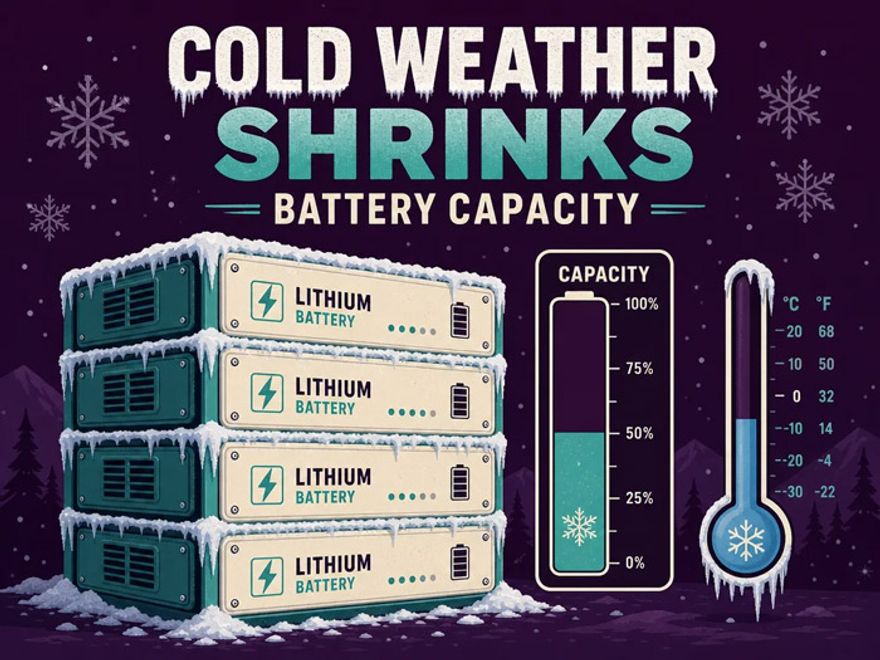
What this means in practice:
- Discharging in the cold is fine. A LiFePO4 bank still delivers 70–80% of its capacity even around -20°C, so your evening loads stay covered through a cold snap — no oversizing required.
- Charging is the one real limit. Most LiFePO4 cells won't accept a charge below 32°F (0°C). Below freezing your bank still powers your loads, but your panels can't refill it until it warms — so a cold snap can draw down a bank you can't recharge.
So the fix isn't a bigger bank — it's a warmer one. House the bank in a conditioned or insulated space, or choose cells with a built-in low-temperature cutoff or self-heating. Keep it above freezing and you hold both full capacity and all-winter charging — which is why the number this calculator gives you already holds in the cold, with no oversizing.
kWh to Amp-Hours: The Conversion Formula
Battery spec sheets usually list capacity in amp-hours (Ah) at a given voltage, while your calculator result is in kilowatt-hours (kWh). Converting between them takes one line of math.
- Use 48 voltsModern off-grid home banks run at 48V — it's the standard for whole-home systems, so that's the voltage to size around.
- Take your energy targetUse the kWh figure from the calculator above and convert it to watt-hours by multiplying by 1,000. A 24 kWh bank is 24,000 Wh.
- Divide energy by voltage24,000 Wh ÷ 48V = 500 Ah. That 24 kWh bank is the same thing as a 500 amp-hour bank at 48 volts — two labels for one battery.
Now you can read any spec sheet: a battery listed as 100Ah at 48V stores 4.8 kWh, so a 24 kWh target means five of them wired together.
Lithium vs. Lead-Acid: What to Buy Today
Lithium Wins on Everything but Upfront Cost
For any battery bank you'd buy today, lithium is the answer — it's what this calculator defaults to and the only chemistry Unbound builds around. Lead-acid still turns up in tight-budget builds and when someone's nursing an existing bank along, so here's the honest trade-off rather than a sales pitch:
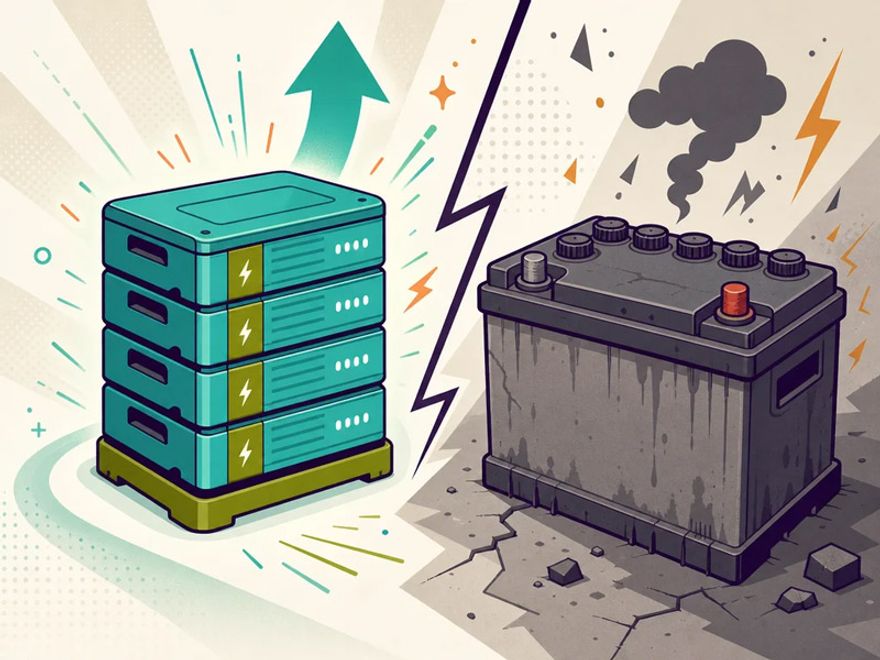
| Lithium (LiFePO4) | Lead-Acid (flooded / AGM) | |
|---|---|---|
| Cost over 10 years | $$ (one bank) | $$$ (2–4 banks) |
| Typical lifespan | 10+ years | 3–7 years |
| Usable capacity (DoD) | 80–95% | ~50% |
| Maintenance | None | Monthly for flooded; must fully recharge daily |
| Venting | None needed | Required / recommended (hydrogen offgas) |
| Cold tolerance | Retains 70–80% in deep cold | Loses ~1% capacity per °F below 77°F |
Compare the same span of time and lithium is the cheaper battery, not the pricier one — a single bank runs for a decade-plus with no maintenance, no venting, and deeper usable discharge, while a lead-acid bank gets replaced two to four times over. That efficiency also means a lithium bank delivers the same usable power at roughly half the size of a lead-acid one. Replacing an aging lead-acid bank? You'll typically need far fewer lithium batteries for the same output.
That's why we size for lithium by default and keep the lead-acid detail brief: for a serious off-grid or backup build today, deep-cycle lead-acid simply isn't the smart money — the lower sticker price is erased several times over by replacements, maintenance, and the extra capacity you buy to work around its 50% discharge limit. We'd rather size you a system that lasts.
The lithium in Unbound systems is Lithium Iron Phosphate (LiFePO4, or "LFP") — chosen for its stability, long cycle life, and built-in electronic protection. For a deeper look at chemistries, high-voltage vs. low-voltage battery architectures, and how the bank wires into the rest of your system, see our full Battery Guide.
From Your Number to a Complete System
Your battery bank size is the anchor for a complete off-grid setup — solar array, inverter, racking, wiring, and storage all sized to work together. How big the array and inverter need to be depends on your location, roof or ground space, and daily loads, so most off-grid systems are spec'd with a short consultation rather than pulled off a shelf.
| Battery bank size | Typical system scale | Roughly the right fit for |
|---|---|---|
| 5–10 kWh | Small array + compact inverter | A weekend cabin or essential backup loads (fridge, lights, well pump) |
| 10–20 kWh | Mid-size array + full off-grid inverter | A full-time small off-grid home |
| 25–40 kWh | Large array + high-capacity inverter | A larger full-time home with heavier daily appliances |
| 40 kWh+ | Multiple strings + stacked storage | Heavy loads, a workshop, or a bigger home running everything |
Match the kWh number the calculator gave you to the tier above for a sense of scale. Because the exact array and inverter depend on details a calculator can't see, the next step is a quick system quote — get a complete system cost estimate or request a consultation to turn your number into a buildable system.
Your Number Is the Starting Point
What a Calculator Can't See
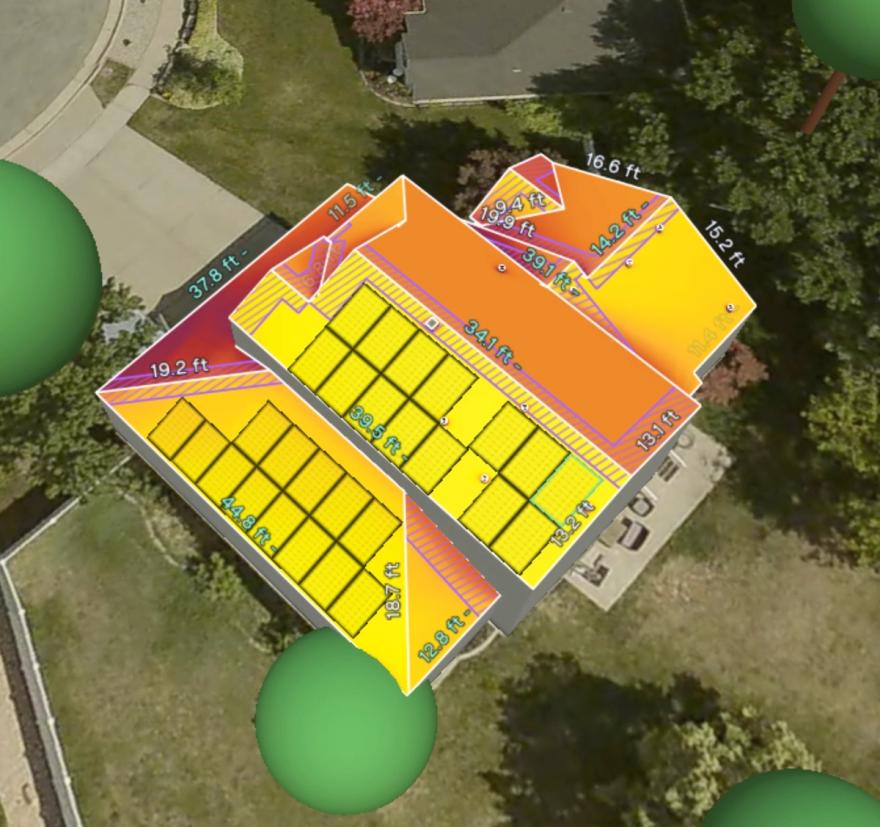
This calculator gets you a solid battery bank estimate in minutes. A complete design also accounts for things a calculator can't see: shading and roof angle that change real-world charging, and fire and setback codes (which differ by jurisdiction) that determine how much usable roof space you actually have.
The low-pressure next step is simple: see what a complete kit built around your battery number would cost, and talk to a technician only if it fits your budget. Unbound has spent 20 years helping DIYers and professional installers spec professional-grade equipment correctly the first time — you're sizing this yourself, but you're not doing it alone. New to solar entirely? The Getting Started Guide walks the whole path from first estimate to flipping the breaker.
More Topics & Resources
Keep building your off-grid system with the rest of our solar library:
- Battery Buying Guide — chemistry, lifespan, and how to match a bank to your system
- Introduction to Charge Controllers — how your panels safely charge the battery bank
- Introduction to Solar Inverters — sizing the inverter for your loads and their startup surge
- Solar Panel Buying Guide — sizing the array that recharges your bank each day
- Estimate a Complete Solar Kit — price a full system with battery, inverter, and panels matched to work together
Battery bank sizing FAQ
Straight answers, sourced from real searches.
Divide your daily energy use (kWh) by your battery's usable depth of discharge. For a lithium (LiFePO4) bank at 80% usable, that's 10 kWh/day ÷ 0.8 = 12.5 kWh of storage. The calculator above runs this from your appliance list and gives you the result in both kilowatt-hours and amp-hours.
Divide your total required storage (kWh) by the usable capacity of one battery module. Modern lithium banks are built from stackable 48V modules, so a typical off-grid home runs anywhere from one large module to several stacked together. The calculator gives you the total kWh; your installer matches it to a specific module count.
For a true off-grid home, size the bank to carry one solid day of your loads — the sun refills it each afternoon — and lean on a generator for the occasional long cloudy stretch rather than buying a battery big enough to ride out a week. Enter the loads you plan to run above and the calculator gives you that one-day bank size.
Two clocks matter. Runtime is how long one charge powers your loads — your bank size divided by your daily use, so a one-day bank runs about a day between charges. Lifespan is how many years the battery serves you: a LiFePO4 lithium bank lasts 10+ years and thousands of charge cycles, far longer than the older lead-acid chemistries it replaced.
Take your average daily energy use and divide by your usable depth of discharge. A typical 10 kWh/day off-grid home needs about 12.5 kWh of lithium storage (10 ÷ 0.8). Heavier homes scale up from there — the calculator sizes it from your actual loads in under a minute.
Amp-hours (Ah) measure electric charge at a specific voltage; kWh measures total usable energy. Convert with kWh = (Ah × Voltage) ÷ 1000 — for example, a 500Ah battery at 48V stores 24 kWh.
Lithium (LiFePO4) costs more upfront but needs no maintenance, lasts 10+ years, and lets you safely use 80-95% of its capacity — so a lithium bank can be 50-60% smaller than a comparable lead-acid bank for the same usable power. Lead-acid costs less upfront but needs monthly maintenance, vents outdoors, and typically only allows 50% discharge.
Not if you house it right. A LiFePO4 bank still delivers about 70-80% of its capacity even around -20°C, so discharge holds up in the cold. The real catch is charging — most lithium can't accept a charge below freezing. The fix isn't a bigger bank; it's keeping the bank in a conditioned or insulated space so it stays above freezing, which protects both its charging and its full capacity.
Ready to build around this number?
This calculator gets you a solid battery bank estimate in minutes — but a complete design also accounts for things a calculator can't see: shading and roof angle that affect real-world charging, and fire/ridge setback codes (which differ by jurisdiction) that determine how much usable roof space you actually have. The low-pressure next step is simple: see what a complete kit built around this battery bank would cost, then talk to a technician only if it fits your budget. Unbound has spent 20 years helping both DIYers and professional installers spec professional-grade equipment correctly the first time — you're sizing this yourself, but you're not doing it alone.