
Solar Basics · Charge Controllers
MPPT Explained: What It Is & How Charge Controllers Work
MPPT (Maximum Power Point Tracking) pulls 10–30% more power from your panels. How it works, MPPT vs PWM, and how to tell if your inverter already has it.
What Is MPPT? (Maximum Power Point Tracking, in Plain English)
MPPT — full form: Maximum Power Point Tracking — is the technique a charge controller or inverter uses to squeeze the maximum available power out of a solar array at every moment of the day.
A solar panel doesn't produce a fixed amount of power. What it produces depends on the voltage you make it run at. Push it to run at too low a voltage and you get lots of current but not many volts. Let it run at too high a voltage and current collapses toward zero. Somewhere between those two extremes there's a sweet spot — one specific voltage where volts × amps is at its absolute peak.
That sweet spot is the maximum power point (you'll see it on a spec sheet as Vmp or Vpp, peak power voltage). MPPT is the act of hunting for it, continuously, as conditions change.
And conditions change constantly. Vmp moves with sunlight intensity and — much more dramatically — with cell temperature. A typical "12V nominal" panel is built with a Vmp of about 17V at a 25°C cell temperature. On a scorching day that sags to around 15V. On a freezing morning it climbs to around 18V. A fixed-voltage system is only correct twice a day by accident. MPPT is correct all day.

Two things MPPT is not:
- It is not a brand, and it is not automatically a separate component you have to buy.
- It is not a way to pull more power out of a panel than the panel can physically make. What it does is stop you from wasting the power the panel is already producing.
How Does MPPT Work?
The car transmission analogy
The cleanest way to understand MPPT is to think about the transmission in a car.
When the transmission is in the wrong gear, the wheels don't receive maximum power — the engine is running either slower or faster than its ideal speed range. The transmission's job is to couple the engine to the wheels in a way that lets the engine stay in a favorable speed range, in spite of varying acceleration and terrain.
Now map that onto solar:
| Car | Solar system |
|---|---|
| Engine | The solar array |
| Engine speed | Array voltage |
| Ideal engine speed range | Vmp — the maximum power point |
| Wheel speed | Battery voltage (roughly 11–14.5V on a 12V bank, depending on state of charge and loads) |
| Transmission | The MPPT converter |
| Low gear: less speed, more torque | Less voltage, more current |
A transmission trades speed for torque. MPPT trades voltage for current. If there's excess voltage available from the PV array, MPPT converts it into additional current going into the battery. And like an automatic transmission, it tracks — as Vmp drifts with temperature and sun, the converter continuously adjusts the ratio to keep the array sitting on its peak.
That covers the core mechanism. The sections below get into how it's implemented in hardware.

What's actually happening electrically
Under the hood, an MPPT controller is a DC-DC converter with a microprocessor telling it what to do.
- It samplesMany times per second, it measures the array’s voltage and current.
- It huntsA tracking algorithm searches for the peak of the power curve. The two you’ll see named on spec sheets are perturb and observe (nudge the voltage a little, see if power went up, keep going that direction) and incremental conductance (compare the rate of change of current to the rate of change of voltage; when they balance, you’re at the peak — faster and less jittery than P&O, but more computation).
- It convertsThe converter steps the array’s high voltage down to whatever the battery needs, and the power that would have been lost comes out the other side as extra amps.
Power in ≈ power out. Volts down, amps up. Modern MPPT controllers do this at roughly 93–98% conversion efficiency — there are real losses, just as there's real friction in a car's transmission, but they're small.
Why the surplus voltage exists at all
To push charge into a battery, the array has to present a voltage higher than the battery's. If the array's Vmp falls even slightly below battery voltage, current collapses toward zero — like an engine turning slower than the wheels.
So panels are deliberately built with voltage headroom. A basic PWM controller throws that headroom away, and an MPPT controller converts it back into usable charging current.
And with modern panels the headroom is enormous. A 60-cell or 72-cell panel — the standard residential module — has a Vmp somewhere around 31–41V. Connect that directly to a 12V battery and you don't just waste a little; you waste most of the potential. This is the single biggest reason MPPT went from a nice-to-have to the default. The panels changed.
How Much Extra Power Does MPPT Actually Give You?
It depends on your array, your climate, and your seasonal load pattern. Any source that quotes a single flat number is oversimplifying.
MPPT gives you a meaningful current boost only when Vmp is more than roughly 1V above battery voltage. That condition is met almost all the time with modern panels — and only sometimes with old voltage-matched ones.
Worked example: MPPT on a cold winter day
This is where MPPT earns its keep.
- Cold cell temperatureIt’s 20°F (-7°C) outside with a little wind, so the panel warms to only about 32°F (0°C).
- High panel VmpAt that cell temperature the array’s Vmp climbs to 18V.
- Low battery voltageThe bank is a little low and loads are on, so it sits at 12.0V.
The ratio of Vmp to battery voltage is 18:12 = 1.5:1.
Under these conditions a theoretically perfect MPPT — with no voltage drop in the array circuit — would deliver a 50% increase in charge current. In reality there are conversion losses, and reports from the field consistently show increases of 20 to 30%.
Now notice the timing. If your energy use peaks in winter (typical for most homes) and you have cold winters, MPPT delivers its biggest boost precisely when you need it most. That timing comes directly from the temperature coefficient of silicon, which lifts panel voltage as temperatures drop.
The honest counter-case: when MPPT barely helps
In hot weather, with a genuinely voltage-matched panel and a battery that's already near full, Vmp sags toward battery voltage and the MPPT advantage shrinks toward nothing. Victron's own engineering literature says this plainly: at high cell temperatures, on a classic 36-cell panel charging a 12V battery, the performance difference between PWM and MPPT becomes negligible.
Real-world testing lines up with that shape:
| Condition | Typical MPPT advantage over PWM |
|---|---|
| Cold (below ~50°F / 10°C) | ~20–30% |
| Moderate (50–77°F / 10–25°C) | ~15% |
| Hot (above ~86°F / 30°C) | ~8–12% |
| Hot and voltage-matched panel and full battery | Near zero |
| Mismatched panel (e.g. a 60-cell module on a 12V bank) | Very large — MPPT is effectively mandatory |
MPPT recovers the power you would otherwise lose to the voltage gap between your panels and your battery. The bigger that gap, the more there is to recover — and with modern panels, it is almost always large.
Does My System Already Have MPPT?
For most readers, this is the practical question. The table below maps each type of equipment to whether it has MPPT built in.
| Your equipment | Does it have MPPT? | How many trackers | Examples |
|---|---|---|---|
| Standalone MPPT charge controller | Yes — it is the MPPT | Usually 1 | Victron SmartSolar, MidNite Classic, Morningstar TriStar MPPT, OutBack FlexMax, Schneider MPPT |
| All-in-one hybrid inverter | Yes, built in | Typically 2–3 | Sol-Ark 15K (3 trackers), EG4 18kPV (3 trackers), Growatt, Deye |
| Inverter/charger (no PV input) | No — this surprises people | 0 | Victron MultiPlus & Quattro, Schneider XW Pro, SMA Sunny Island. These invert and charge from AC. Solar has to come from a separate MPPT charge controller or an AC-coupled PV inverter. |
| Grid-tie string inverter | Yes, built in | 1–3 | SMA Sunny Boy, Fronius Primo, Growatt, Sungrow |
| Microinverters | Yes — one per unit | 1 per panel (or per input on multi-panel units) | Enphase IQ8, Hoymiles, APsystems |
| DC optimizers | Yes, but relocated | 1 per module | SolarEdge, Tigo (see the optimizer section below) |
| AC-coupled battery | No — it has no PV input | 0 | FranklinWH aGate/aPower pairs with your existing PV inverter |
| Portable power station | Usually yes on the solar input | 1–2 | EcoFlow, Bluetti, Anker; older or budget units may still be PWM |
The quickest physical check: does your unit have PV input terminals (DC wires coming in from the panels)? If yes, it has MPPT — nothing accepts raw array DC in a modern system without tracking it. If your inverter only has battery, grid, and load connections, it has no MPPT and something else is harvesting your solar.
The rest of this guide walks through each of those architectures.
MPPT Charge Controllers: The Standalone Approach
This is the classic, and it's still the right answer for a huge number of builds.
Here the MPPT lives in its own box between the array and the battery. Its only job is to harvest solar and charge the bank correctly — tracking the maximum power point on the input side, and managing bulk/absorption/float charge stages on the output side.
Where this architecture still dominates:
- RVs, vans, and boats — where you're charging a modest 12V or 24V bank and the whole system is DC-centric
- Cabins and small off-grid homes
- Marine systems
- Modular builds, especially Victron-based ones, where people deliberately want separate, individually replaceable components rather than a single all-in-one box
- Any system built around an inverter/charger with no PV input (MultiPlus, XW Pro, Sunny Island) — these require a companion controller
Brands worth knowing: Victron (SmartSolar/BlueSolar), MidNite Solar (Classic), OutBack Power (FlexMax), Morningstar (TriStar/ProStar), Schneider Electric.
The trade-off is straightforward: more boxes, more wiring, and more configuration — in exchange for the freedom to choose, tune, repair, and expand each component on its own. For an experienced builder who wants that level of control, a modular stack is hard to beat. For most homeowners, though, that same control is work they would rather hand off — which is exactly what the integrated hybrids in the next section are built for.
If you're new to the category, start with our Introduction to Charge Controllers, then browse MPPT charge controllers or browse all charge controllers.
MPPT in String Inverters: Why Two Trackers Beat One
In a grid-tied system there's usually no battery and no charge controller. Panels are wired in series strings and run straight into a string inverter, which converts DC to AC for your house and the grid.
The MPPT is inside that inverter. It tracks the maximum power point of the whole string.
Which raises an obvious problem: what if all your panels aren't seeing the same sun?
A string of panels is wired in series, so they all carry the same current — and the string as a whole gets tracked to a single operating voltage. If half your panels face east and half face west, they peak at completely different times of day and at different operating points. A single tracker has to compromise between them, and both halves lose.
The fix is multiple independent MPPTs. A dual-MPPT inverter runs two separate strings at two separate optimal voltages, simultaneously. The east string peaks in the morning, the west string peaks in the afternoon, and neither one drags the other off its maximum power point.
You need separate trackers whenever a group of panels will produce differently from another group:

- Different roof orientation (east/west, or north-ish faces in some layouts)
- Different tilt angles
- Different shade patterns through the day
- Different panel models or wattages
- A roof array plus a ground-mount array
Sizing strings correctly — how many panels in series, how many strings in parallel, and what that does to voltage in the cold — is its own topic. See our string sizing guide and the Introduction to Solar Inverters.
MPPT in Hybrid & All-in-One Inverters
Hybrid inverters are where most of the residential market has moved — and the reason is straightforward. Rather than assembling an inverter, an MPPT charge controller, a battery charger, transfer equipment, and monitoring as separate boxes, a modern hybrid folds all of those functions into a single coordinated platform that one manufacturer designs, supports, and stands behind.
A hybrid inverter combines, in one enclosure:
- MPPTHarvests DC from the array.
- Battery chargerManages the bank.
- InverterDC → AC for your loads.
- Grid interactionImport, export, sell-back where allowed.
- Backup / islandingRuns your loads when the grid drops.
- Energy managementDecides, moment to moment, whether solar goes to the house, the battery, or the grid.
Only the first of those is MPPT. When someone says "my Sol-Ark handles everything," the MPPT is doing exactly one part of "everything" — finding the array's peak power. The energy-management brain is a separate function that happens to share a chassis.
Real tracker counts, so you don't have to guess:
- GoodWe 11.4K-MS-US — 3 independent MPPTs, 1 PV string per tracker (600 VDC max)
- Solis 16K-US — 3 independent MPPTs, accepting 2 PV strings per tracker
The number of MPPTs matters more than the number of string inputs. Two strings that share one MPPT are still controlled by a single tracker, so if one of them falls into shade, both are pulled off their best operating point together. When you match an array to a hybrid inverter, plan around the independent tracker count.
Integrated or component-built? It comes down to control
It is tempting to read all-in-one as the simple choice and separate components as the capable one. For most homeowners, that gets it backwards. A reputable integrated platform is a fully engineered system — the manufacturer has already matched the MPPT, charger, and inverter to work together and warranties them as a unit. Building from components gives you control over every part, but it does not automatically buy you more capability.
So the real deciding factor is how much of the design, configuration, and long-term tinkering you want to own. Advanced DIY builders who enjoy that control are well served by a modular stack. Most other homeowners are better served by a coordinated hybrid platform.
Integrated platforms worth knowing
In our experience, homeowners who want a dependable system without constantly adjusting or rebuilding it are usually best served by a reputable integrated platform. GoodWe is a strong fit for many average grid-tied homes, while Solis is often better suited to larger systems and more demanding grid-tied or off-grid applications. Sol-Ark and Tesla are well-established options in the integrated energy-storage market as well.
- GoodWeOur go-to for typical grid-tied homes. A reliable, transformerless hybrid that gives you a clean, well-supported system without turning solar into an ongoing hobby.
- SolisBuilt for larger homes and more demanding builds, including projects with off-grid or backup-power needs. Also transformerless and fully integrated for modern residential use.
- Sol-ArkA respected, widely known hybrid brand we carry and trust. A strong performer — just not always the best price-to-support balance for an average grid-tied home.
- TeslaOne of the clearest signs the whole industry is moving toward tightly integrated energy systems. We offer it for homeowners who want that ecosystem.
- EG4Widely discussed in the DIY market and positioned as a more budget-conscious option. If you are comparing it with GoodWe, Solis, Sol-Ark, or Tesla, weigh warranty support, technical assistance, system integration, and long-term service availability alongside the sticker price.
- What would a full system cost?Want to see what a typical complete system would cost with one of these integrated all-in-one hybrid platforms?See what it would cost →
And the important exception, which trips up a lot of people: the Victron MultiPlus and Quattro, the Schneider XW Pro, and the SMA Sunny Island are inverter/chargers, not solar-harvesting hybrids. They have no PV input and no MPPT. In a Victron system, the MPPT comes from a separate SmartSolar or BlueSolar charge controller; in a Schneider system, from a companion MPPT unit; in a Sunny Island system, from an AC-coupled grid-tie inverter. They're excellent products — they just aren't doing the harvesting.
If you're weighing an all-in-one against a modular stack, our Inverter Buying Guide walks through the trade-offs, and grid-tied vs. off-grid solar covers which architecture your situation calls for.
MPPT in Microinverters: One Tracker Per Panel
Microinverters take the idea to its logical conclusion: give every single panel its own MPPT.
An Enphase IQ8, a Hoymiles unit, or an APsystems microinverter sits under the panel (or serves 2–4 panels with independent tracking per input) and converts that panel's DC to AC right there on the roof. Each one contains its own maximum power point tracker.
When microinverters are the right call, Enphase is what we recommend — the IQ8 series is an excellent, proven product. Just go in knowing you pay a real premium for putting a small inverter under every panel.
Why that matters: in a string, panels are chained in series. One panel that's shaded, soiled, snow-covered, leaf-covered, degraded, or simply a different model can pull the entire string's operating point away from where the healthy panels want to be. Every panel on that string produces less.
With a microinverter, only that one panel produces less. The rest of the array is unaffected, because every panel is tracked and inverted independently.
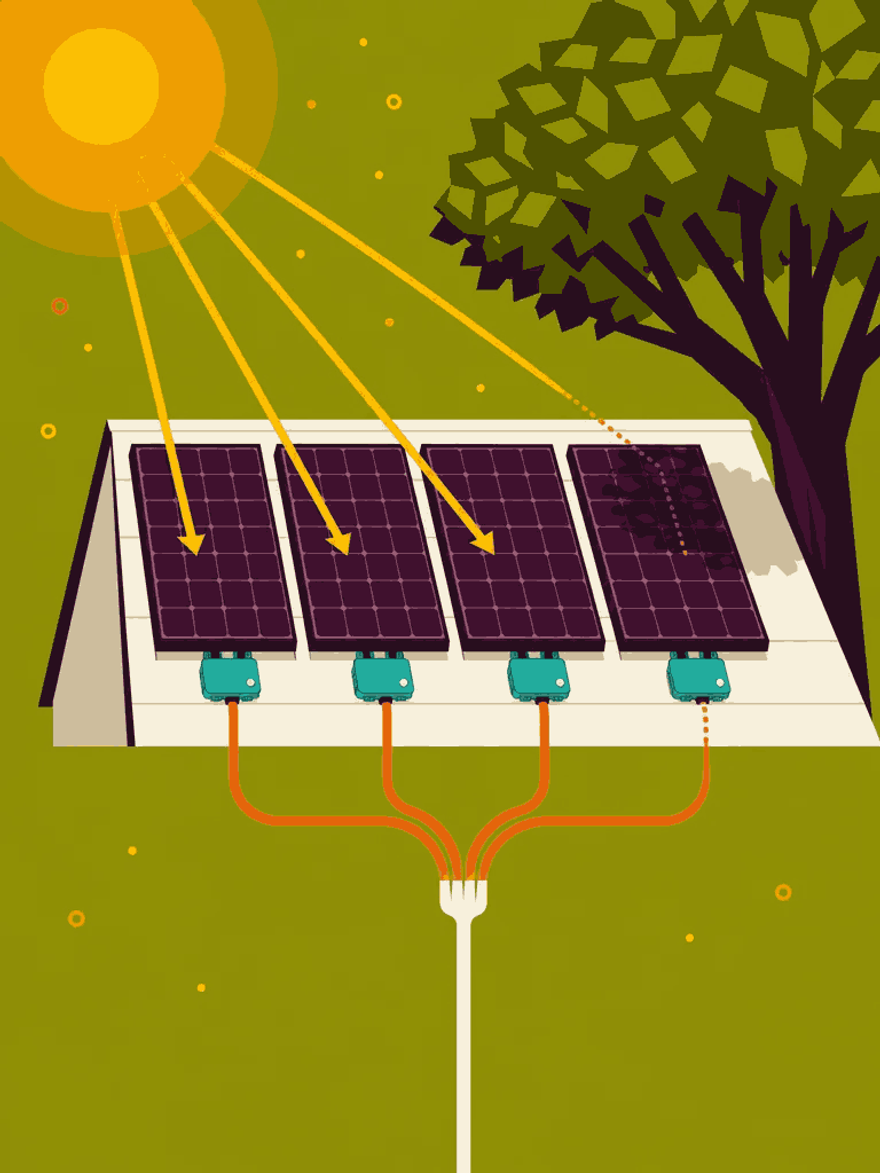
When per-panel MPPT is genuinely worth it:
- Complex or multi-faced roofs
- Any roof with real shade — a chimney, a vent stack, a neighbor's tree
- Snow that clears unevenly
- Mixed panel models, or a system you expect to expand piecemeal
- Situations where you want per-panel monitoring to find the one underperformer
When it isn't: a clean, unshaded, single-plane roof where a string inverter (with an appropriate number of trackers) will harvest nearly the same energy for less money and fewer rooftop electronics.
It is also worth knowing that a string inverter handles many of these situations on its own. Modern panels use bypass diodes and half-cut cell layouts that limit how much partial shade drags down a string, and where a roof does give up a little to shade, adding a panel or two to the array usually makes it up for far less than a microinverter on every module. Microinverters also add more points of failure in a harsh spot — bolted under the panel, where rooftop heat is trapped and temperature swings are extreme — while a single string or hybrid inverter can sit in a cooler, serviceable location. For many homes the real-world energy gain does not justify the premium.
Batteries tip the math further. Microinverters convert DC to AC up on the roof, so an AC-coupled system has to convert that power again to charge a battery, losing a little efficiency at each step. As more homes add storage, DC-coupled string and hybrid inverters are the more efficient and easier-to-manage option — which is a big part of why string inverters are gaining ground again.
For the full comparison, see string inverters vs. microinverters.
MPPT vs. DC Optimizers (SolarEdge and Tigo)
Optimizers are the third module-level architecture. They're often confused with microinverters, though the two work in fundamentally different ways.
A DC optimizer is a small DC-DC converter mounted behind each panel. It does module-level work — but it outputs DC, and a central string inverter still does the DC→AC conversion.
The two major approaches differ in a way that matters:
- SolarEdge moves the MPPT function down to the optimizer. Each optimizer tracks its own panel's maximum power point, and the string inverter holds the string at a fixed voltage. The inverter isn't doing the tracking anymore — the optimizers are.
- Tigo takes a lighter-touch approach: the string inverter keeps doing normal string-level MPPT, and Tigo optimizers are added selectively, typically only on the panels that actually have a shade or mismatch problem. It's a targeted fix rather than a whole-system architecture.
| Microinverters | DC optimizers | String inverter alone | |
|---|---|---|---|
| Where MPPT happens | Per panel | Per panel (SolarEdge) or per problem panel (Tigo) | Per string |
| Output from the roof | AC | DC | DC |
| Central inverter needed? | No | Yes | Yes |
| Handles per-panel mismatch | Best | Very good | Only via multiple trackers |
| Rooftop electronics count | Highest | High | Lowest |
All three are legitimate. The right choice depends on your roof — its shading, its orientation, and your budget — more than on any brand's marketing.
MPPT vs. PWM: Which Charge Controller Do You Need?
When This Choice Still Matters
First, some scoping: most people buying a complete residential system today never make this choice. Their hybrid inverter or string inverter already includes MPPT, so the PWM-versus-MPPT question never comes up.
This decision is still live in exactly four places: RVs, boats, small cabins, and DIY battery charging — where a standalone controller is still a real purchase.
Looking for a complete system?Unbound delivers all-inclusive grid-tied and off-grid solar packages — premium equipment with permitting and interconnection handled for you. We don't sell RV, boat, or parts-only components.See what a system would cost →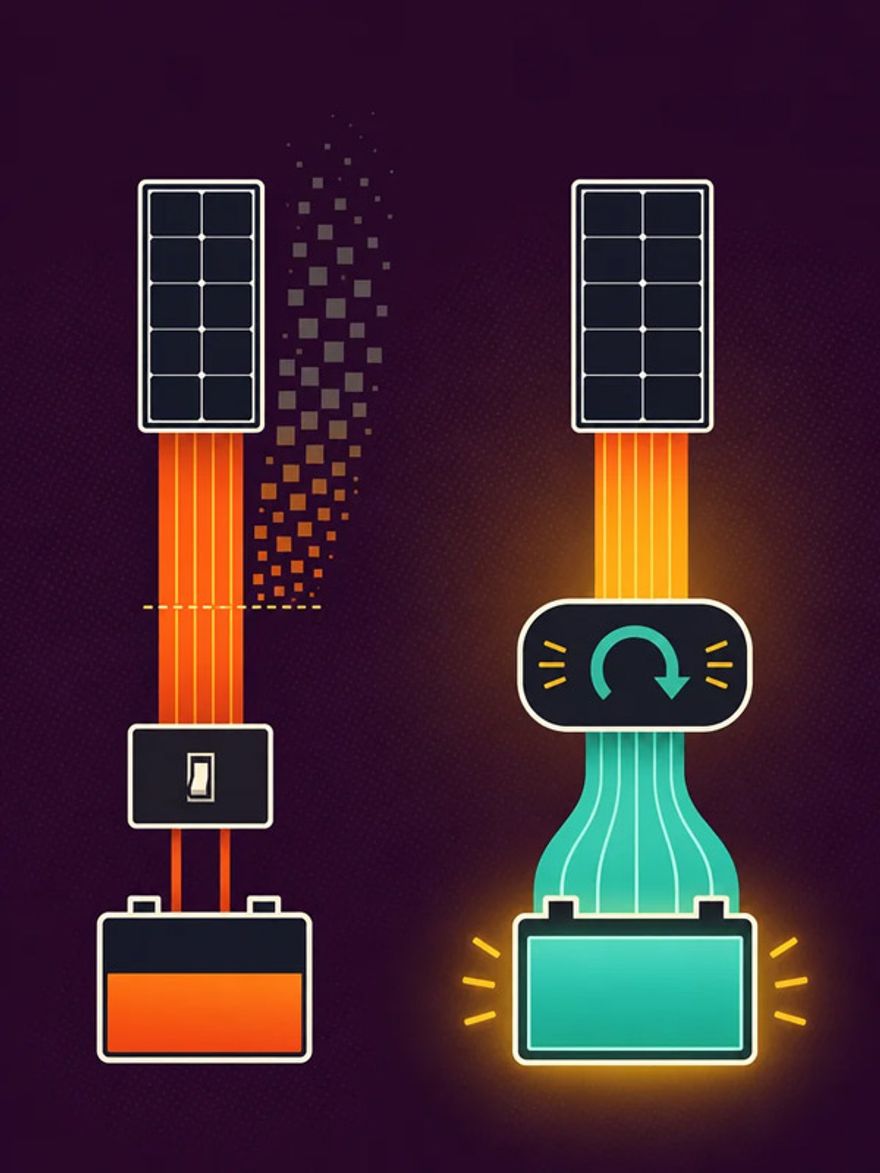
How PWM works
A PWM (Pulse Width Modulation) controller is essentially a fast switch between the array and the battery. When it's connected, the panel is dragged down to battery voltage. There's no conversion. Any voltage the panel could have produced above the battery's voltage is simply discarded — traditional controllers transfer PV current directly to the battery and give you no benefit whatsoever from that extra potential.
How MPPT differs
MPPT lets the panel run at its own optimal voltage, then converts the surplus into extra current. Volts down, amps up, ~93–98% of the power preserved.
The decision table
| Your situation | Use |
|---|---|
| Modern 60-cell or 72-cell panel (Vmp 31–41V) on a 12V or 24V bank | MPPT. Not optional — PWM would waste most of the array's potential. |
| Any array over roughly 200–300W | MPPT. The extra harvest pays back the price difference fast. |
| Cold climate, or winter-peaking loads | MPPT. This is where the gain is largest. |
| Array voltage well above battery voltage for any reason | MPPT. |
| One small "nominal 12V" 36-cell panel, hot climate, trickle-charging a 12V battery | PWM is defensible. It's cheaper, simpler, and nearly as good in that narrow case. |
| Tiny maintenance/trickle charging (gate opener, trailer battery) | PWM is fine. |
Why MPPT is superior in principle: PWM's ceiling is the panel's current at battery voltage. MPPT's ceiling is the panel's power. Those match only when the panel's Vmp happens to sit right at battery voltage — an alignment that modern panel design has made rare.
One note on portable power stations: most current-generation units from EcoFlow, Bluetti, Anker, Jackery, and Goal Zero use MPPT on their solar input. Older and budget units sometimes still use PWM, which is a big part of why two power stations with identical "200W solar input" ratings can harvest noticeably different amounts of energy from the same panel. Check the spec sheet, not the box.
Does MPPT Fix Shading?
This is the most widespread misconception about MPPT.
MPPT does not fix shade.
MPPT finds the best operating point available. It cannot create sunlight. If a tree branch is covering a third of your array, MPPT will faithfully locate the maximum power point of a partly shaded array — and that maximum is a lower number than it would have been in full sun. Tracking the peak of a smaller curve doesn't make the curve bigger.
What MPPT genuinely helps with under shade is subtler: a partly shaded string has a lumpy power curve with more than one local peak, and a good tracking algorithm sweeps the range to find the global maximum instead of settling on a lesser local one. That helps at the margins, but it only recovers a little of the power that is left — the underlying shade loss remains.
What actually reduces shade losses:
- Put panels where the sun isSite the array in the sunniest spots available. Some shade is normal and often unavoidable — a good design simply plans around it.
- Modern panels with bypass diodesToday's panels use multiple bypass diodes and half-cut cell layouts that route current around a shaded section, so partial shade costs far less than it used to.
- Smart string designGrouping panels that share a shade pattern and sizing each string correctly keeps every part of the array performing its best — a core part of the engineering we handle for you.
- Multiple MPPT trackersA shaded group can run on its own tracker, independently of an unshaded one, so one area never holds another back.
Notice that "buy a better charge controller" is not on that list. Mismatch loss is a system architecture problem, while MPPT is a voltage optimization function — the two operate at different layers of the system.
What about bypass diodes?
Modern solar panels include built-in bypass diodes that let electricity route around heavily shaded sections of a panel. They help prevent hot spots and allow the rest of the panel to keep producing power. MPPT then optimizes whatever power is still available from the array — the two work at different layers and never compete.
Want to learn how bypass diodes, half-cut cells, and modern panel designs improve shade performance? Read our Solar Panels Guide.
How Many MPPTs Do You Need? (Dual MPPT, Triple MPPT, and Why)
Hybrid and string inverters advertise 2 MPPT, 3 MPPT, sometimes 4 MPPT, and the spec sheets almost never explain what you're supposed to do with that number.
The rule is simpler than the spec sheets make it sound:
"Produce differently" means any of:
- Different orientation — an east-facing array and a west-facing array peak at different times of day
- Different tilt — a 15° roof and a 40° roof see different irradiance curves
- Different shade patterns — one array clears the tree line at 9am, the other at noon
- Different panel models or wattages — mixing modules on one tracker forces a compromise voltage
- Different mounting — a roof array and a ground-mount array are, electrically, two different animals
Worked examples:
| Layout | Trackers needed |
|---|---|
| All panels on one unshaded south roof plane | 1 |
| East roof + west roof | 2 |
| South roof + a ground mount | 2 |
| Three roof faces, or two faces plus a shaded section | 3 |
| One plane now, but you're adding a ground mount in two years | 2 — buy the headroom |
And a practical caveat: a tracker has a maximum input current and voltage. If a group of panels is large enough, you may need multiple strings on the same tracker, which is fine — as long as those strings are electrically identical (same panel, same count, same orientation). Two dissimilar strings paralleled onto one tracker gives you exactly the compromise you were trying to avoid.
Getting this wrong is one of the more expensive DIY mistakes, because the fix is usually a different inverter. It's worth checking against a string sizing guide before you buy — or just see what a correctly-matched complete kit costs and skip the arithmetic.
How to Size an MPPT Charge Controller
The Two Numbers That Matter
Buying a standalone MPPT charge controller comes down to two numbers. One sets how much power you can capture; the other decides whether the controller survives its first cold morning.
- Output current — the amps the controller has to push into the battery. You size it from your array watts and battery-bank voltage, then add headroom so it is not running flat out.
- Maximum input voltage — the ceiling your array voltage can never cross. It climbs as the temperature drops, so the danger point is a clear, freezing morning, not a hot afternoon.

1. Output current (the easy one)
| Array | Battery bank | Output amps | Controller to choose |
|---|---|---|---|
| 1,200 W | 24 V | 1,200 ÷ 24 = 50 A | 60 A |
| 800 W | 12 V | 800 ÷ 12 = 67 A | 80 A |
| 3,000 W | 48 V | 3,000 ÷ 48 = 63 A | 80 A |
Notice how quickly a 12V bank pushes you toward big, expensive controllers — the main argument for building at 24V or 48V.
Why the headroom? Because on a cold, bright day with reflection off snow, a panel can briefly exceed its STC rating. A controller running at exactly 100% of nameplate has nowhere to go.
2. Maximum input voltage (the one that kills controllers)
This is where DIYers destroy hardware. Every MPPT controller has a maximum PV input voltage — 150V, 250V, 600V, whatever the spec sheet says. Exceed it and you can permanently damage the unit, often instantly, often not under warranty.
Panel Voc rises as temperature falls, at roughly -0.28% to -0.35% per °C (check your panel's actual temperature coefficient on its spec sheet). A string that measures a comfortable 130 Voc on a mild afternoon can climb well past 150V on a still, sunny, 0°F morning — and that's exactly the morning your 150V controller dies.
Rule: calculate cold-morning Voc using your site's record low temperature, not your average low. The panel doesn't care that -10°F is unusual. It only has to happen once.
Also confirm your wire gauge can carry the current without excessive voltage drop — see the wire sizing guide — and consider whether you want to oversize your PV array by 10–20% relative to the controller, which is standard practice and usually a net win.
For the battery side of the equation, use the battery bank sizing calculator and read up on deep-cycle batteries and the best solar batteries on the market.
Where to Go From Here
Know MPPT. Now get the match right.
Understanding MPPT is the easy half. The hard half is matching an array to a controller or hybrid inverter that won't be overvoltaged on the coldest morning of the year — and laying panels out around the fire and ridge setbacks your jurisdiction actually enforces. That setback rule is where DIY permit packages get rejected, because people design for roof space they aren't allowed to use.
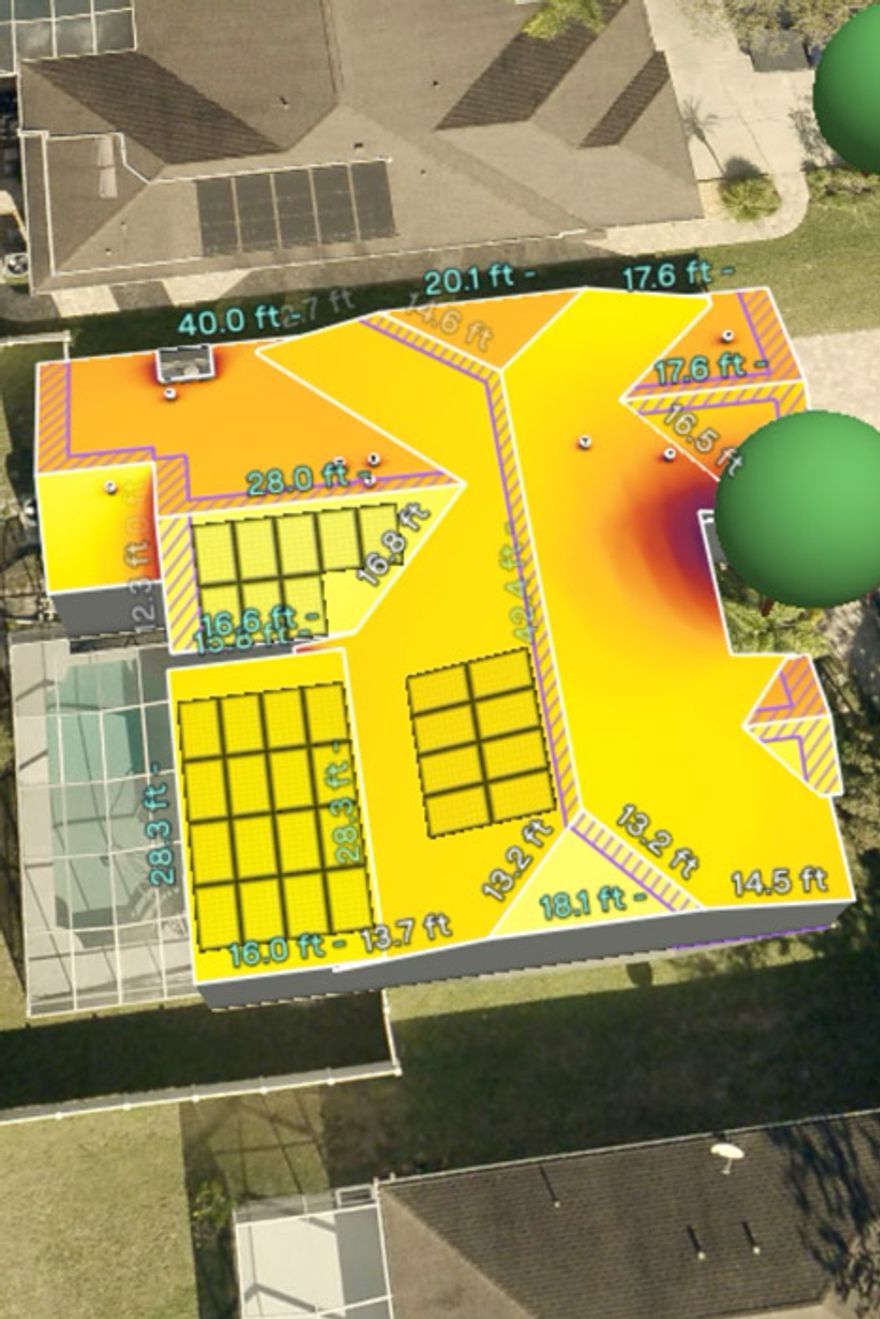
A real design uses irradiance mapping, shading analysis, and your true roof angle and azimuth, reviewed by a technician who knows your local authority having jurisdiction. Software plus a human who has seen your county's rejections before is what keeps a permit package from bouncing.
The low-pressure path: see what a complete kit costs first, and only talk to a technician if the numbers fit your budget and goals. For 20 years Unbound Solar has supplied professional-grade equipment to DIYers and professional installers alike — the best value on equipment, done right. You're not doing it alone.
→ See what your solar kit would cost
Still figuring out scope? Run the solar cost estimator, size an off-grid build with the off-grid solar calculator, or start at the beginning with the Getting Started Guide.
More Topics & Resources
Keep going with the rest of our solar library:
- Introduction to Charge Controllers — how controllers work and how to pick one
- Introduction to Solar Inverters — string, hybrid, and micro inverters compared
- Solar Panel Buying Guide — bypass diodes, half-cut cells, and shade performance
- Battery Buying Guide — sizing and chemistry for your bank
- String inverters vs. microinverters — the full cost-and-shade comparison
- The effect of shade on solar panels — what shade really costs you
Questions people actually ask
Straight answers, sourced from real searches.
MPPT stands for Maximum Power Point Tracking. It is a control technique — not a brand or a specific box — that continuously adjusts the voltage a solar array operates at so the array delivers the most watts it possibly can under current sun and temperature conditions.
It does two things at once. It finds the panel voltage that produces peak power (the maximum power point), and it runs a DC-DC converter that trades that surplus voltage for extra current at whatever voltage the battery or inverter needs. Volts go down, amps go up, and roughly 93–98% of the power makes it through.
It samples the array's voltage and current many times per second, uses a tracking algorithm (usually perturb-and-observe or incremental conductance) to hunt for the peak of the power curve, then steps the array's high voltage down to battery voltage with a DC-DC converter. The power that would have been thrown away in a direct connection comes out as extra charging amps.
MPPT, in almost every modern system. PWM connects the panel straight to the battery, dragging the panel down to battery voltage and discarding any surplus. MPPT converts that surplus into extra current, typically 10–30% more harvest. PWM is only competitive on a small, voltage-matched 12V system (a true 36-cell 'nominal 12V' panel on a 12V battery) in warm weather — and that hardware is increasingly rare.
Because modern solar panels don't match battery voltage. A 60- or 72-cell panel produces peak power around 31–41 volts; a 12V or 24V battery can't use that voltage directly. Without MPPT, everything above battery voltage is simply lost. MPPT is what converts that surplus voltage into usable charging current.
Three real ones. It costs more than PWM. It adds electronics that can fail, and it must be sized correctly — feeding it more than its rated cold-weather input voltage will destroy it. And it is often oversold: on a hot day with a voltage-matched panel and a nearly full battery, the gain over PWM can be close to zero. MPPT recovers power you were losing; it cannot create power the sun isn't delivering.
No. Grid-tie string inverters, hybrid inverters, and microinverters have MPPT built in. But pure inverter/chargers — Victron MultiPlus and Quattro, Schneider XW Pro, SMA Sunny Island — do not. They invert and charge from AC, and they rely on a separate MPPT charge controller (or an AC-coupled PV inverter) to harvest solar. Always check whether your unit has PV input terminals.
Yes. The EG4 18kPV is an all-in-one hybrid inverter with three independent MPPT trackers built in (up to 600 VDC input each), so you can run three separate strings on different roof planes or tilts without a standalone charge controller.
Yes. Sol-Ark hybrid inverters have MPPT built in — the Sol-Ark 15K, for example, has three MPP trackers accepting two PV strings each. There is no separate charge controller in a Sol-Ark system.
Yes. Every Enphase microinverter (IQ8 series included) contains its own MPPT, so each panel is tracked independently. That is the core advantage of microinverters: one shaded, soiled, or degraded panel can't drag its neighbors down to its operating point.
A dual-MPPT inverter has two independent maximum power point trackers, so it can run two groups of panels at two different optimal voltages at the same time. It's how one inverter can serve an east-facing string and a west-facing string, or two different tilts, without either one dragging the other off its peak.
One tracker for every group of panels that will ever produce differently from another group — different roof orientation, different tilt, different shade pattern, or a different panel model. If all your panels sit on one plane, one tracker is fine. Two roof faces means two trackers; a roof array plus a ground mount means two. Buying one extra tracker you don't use today is cheap insurance if you plan to expand.
No — MPPT keeps working under shade, and on a partly shaded string it will hunt for the best available operating point. But it cannot undo shade. Shade reduces the power the array can produce, and MPPT can only find the maximum of what's actually there. To reduce shade losses you need module-level electronics (microinverters or optimizers) or better panel placement, not a better charge controller.
They solve completely different problems. Bypass diodes live inside the solar panel — typically three of them, one per group of cells — and let current route around a shaded or damaged cell group so it doesn't choke the whole panel or overheat into a hot spot. MPPT lives outside the panel and picks the operating voltage that yields the most power. Diodes protect and reroute; MPPT optimizes.
No. MPPT cannot make a 400W panel produce more than 400W under its rated conditions. What it does is stop you from wasting the power the panel is already making. The '30% more power' claim is 30% more than a PWM controller would have delivered — not 30% more than the panel's rating.
Yes, when there's surplus array voltage to convert. Because MPPT turns excess volts into extra amps, it delivers more charging current from the same panel — most dramatically in cold weather with a partly discharged battery, which is exactly when you need the recovery. Charging still stops at the battery's absorption/float setpoints, so it fills the bank faster, not fuller.
Divide your array's rated watts by your battery bank's nominal voltage to get output amps, then add about 25% headroom. A 1,200W array on a 24V bank is 1,200 ÷ 24 = 50A, so choose a 60A controller. Separately, check the array's open-circuit voltage (Voc) at your coldest expected temperature — Voc rises as it gets colder — and make sure it stays under the controller's maximum PV input voltage.
Know MPPT. Now Get the Match Right.
Understanding MPPT is the easy half. The hard half is matching an array to a controller or hybrid inverter that won't be overvoltaged on the coldest morning of the year, and laying panels out around the fire and ridge setbacks your jurisdiction actually enforces — the setback rule is where DIY permit packages get rejected, because people design for roof space they're not allowed to use. A real design uses irradiance mapping, shading analysis, and your true roof angle and azimuth, checked by a technician who knows your AHJ. The low-pressure path: see what a complete kit costs first, and only talk to a technician if the numbers fit. For 20 years Unbound Solar has supplied professional-grade equipment to DIYers and professional installers alike — best value on gear, done right, and you're not doing it alone.